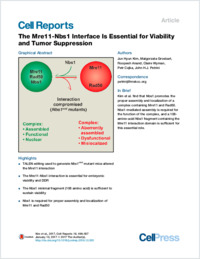
The Mre11-Nbs1 interface is essential for viability and tumor suppression
- Kim, Jun Hyun Molecular Biology Program, Memorial Sloan Kettering Cancer Center, New York, NY 10021, USA
- Grosbart, Malgorzata Department of Molecular Genetics, Erasmus University Medical Center, 3000 Rotterdam, the Netherlands - Department of Radiation Oncology, Erasmus University Medical Center, 3000 Rotterdam, the Netherlands
- Anand, Roopesh Institute for Research in Biomedicine (IRB), Faculty of Biomedical Sciences, Università della Svizzera italiana, Switzerland
- Wyman, Claire Department of Molecular Genetics, Erasmus University Medical Center, 3000 Rotterdam, the Netherlands - Department of Radiation Oncology, Erasmus University Medical Center, 3000 Rotterdam, the Netherlands
- Cejka, Petr Institute for Research in Biomedicine (IRB), Faculty of Biomedical Sciences, Università della Svizzera italiana, Switzerland
- Petrini, John H.J. Molecular Biology Program, Memorial Sloan Kettering Cancer Center, New York, NY 10021, USA
-
10.01.2017
Published in:
- Cell reports. - 2017, vol. 18, no. 2, p. 496-507
English
The Mre11 complex (Mre11, Rad50, and Nbs1) is integral to both DNA repair and ataxia telangiectasia mutated (ATM)-dependent DNA damage signaling. All three Mre11 complex components are essential for viability at the cellular and organismal levels. To delineate essential and non-essential Mre11 complex functions that are mediated by Nbs1, we used TALEN-based genome editing to derive Nbs1 mutant mice (Nbs1mid mice), which harbor mutations in the Mre11 interaction domain of Nbs1. Nbs1mid alleles that abolished interaction were incompatible with viability. Conversely, a 108-amino-acid Nbs1 fragment comprising the Mre11 interface was sufficient to rescue viability and ATM activation in cultured cells and support differentiation of hematopoietic cells in vivo. These data indicate that the essential role of Nbs1 is via its interaction with Mre11 and that most of the Nbs1 protein is dispensable for Mre11 complex functions and suggest that Mre11 and Rad50 directly activate ATM.
- Language
-
- English
- Classification
- Medicine
- License
-
CC BY

- Open access status
- gold
- Identifiers
-
- RERO DOC 327002
- DOI 10.1016/j.celrep.2016.12.035
- ARK ark:/12658/srd1319018
- Persistent URL
- https://n2t.net/ark:/12658/srd1319018
Export to…
Statistics
Document views: 313
File downloads:
- Texte intégral: 268